The Lifeline Assistance Program is a federal benefit administered by the FCC and managed by the Universal Service Administrative Company (USAC). It has been providing affordable communication access to low-income Americans since 1985.
Through Lifeline, qualifying households receive a government phone service discount of up to $9.25 per month — and up to $34.25 per month for households on Tribal lands. Participating government phone companies apply that subsidy to cover the full cost of a phone and plan for eligible customers.
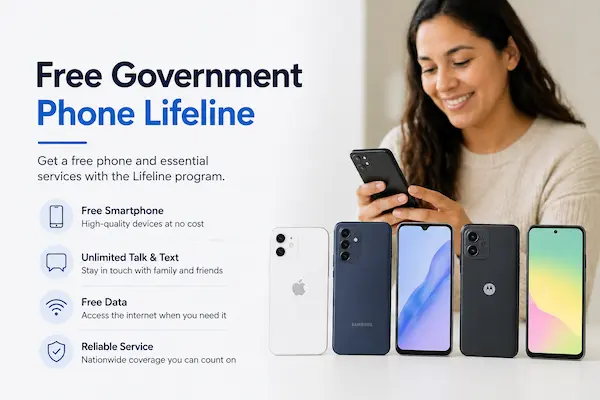
The result is a complete wireless package at $0. You get a real smartphone, free cell service, unlimited talk and text, and monthly data — without paying a single cent.
As of 2026, Lifeline is fully active and accepting applications nationwide. The Affordable Connectivity Program (ACP) ended in May 2024 and is no longer available. Lifeline is the current and only federal free phone program in operation.
The program is legitimate, federally funded, and available in all 50 states, US territories, and Tribal lands. Millions of households are already enrolled and receiving free monthly service every month.
Who Qualifies for a Free Government Phone?
There are two ways to qualify — and most applicants meet at least one of them without realizing it.
By income: Your total household gross income must be at or below 135% of the Federal Poverty Guidelines. For 2026, that means approximately $20,331/year for a single person, $27,594 for two people, and $41,625 for a family of four.
By government program participation: If you or anyone in your household is currently enrolled in SNAP, Medicaid, SSI, Federal Public Housing Assistance, or Veterans Pension, you qualify automatically — regardless of income. A free phone with Medicaid enrollment is one of the fastest approval paths, since the National Verifier database confirms your participation instantly.
SNAP and EBT cardholders qualify immediately. Medicaid, SSI, and Section 8 recipients are automatically eligible. Veterans receiving pension or survivors benefits qualify as well.
One important rule: only one Lifeline benefit per household is allowed — not one per person. If someone at your address is already enrolled in Lifeline, a second benefit cannot be added to the same household unless a separate economic unit can be documented.
What Documents Do You Need to Apply?
The documents required depend on how you qualify — by income or by government program participation.
If you qualify through a government program (SNAP, Medicaid, SSI, etc.): You’ll need a current benefits letter, approval notice, or ID card from the qualifying program. A current SNAP award letter, EBT card documentation, Medicaid card, or SSI benefits statement dated within the past 12 months is accepted. In many cases, the National Verifier confirms your program enrollment automatically through federal databases — no documents needed at all.
If you qualify by income: Acceptable documents include your prior year federal or state tax return (front page only), three consecutive months of pay stubs dated within the past 12 months, a Social Security benefits statement, or pension and retirement income documentation.
For all applicants: You’ll also need proof of your current address — a recent utility bill, lease agreement, or government mail dated within the last 90 days is sufficient.
Make sure all documents are current. Expired benefit letters or outdated pay stubs are the most common reasons applications are delayed or denied. If your documentation is in order, most online applications are processed in 1–2 business days.
Top Free Phone Carriers Available in 2026
Once you’re approved for Lifeline, you’ll choose a participating carrier to receive your free phone and service. Each carrier operates on a major national network and offers a slightly different plan depending on your state.
Assurance Wireless runs on T-Mobile’s 4G LTE and 5G network and is one of the most widely available Lifeline providers in the country. An Assurance Wireless free phone comes with unlimited talk, text, and a generous monthly data allotment. As of April 2026, Assurance is running a limited-time promotion offering twice the standard data for new enrollments.
SafeLink Wireless operates on Verizon and AT&T networks depending on your state, making it a strong option in rural and suburban areas where Verizon’s coverage is strongest. A SafeLink Wireless free phone is available in all 50 states — it’s one of the most accessible options for first-time Lifeline applicants.
AirTalk Wireless is one of the few carriers that offers iPhone models to qualifying applicants in select states, alongside standard Android options. AirTalk Wireless free phones are a top choice if an iOS device is important to you — check device availability in your ZIP code before applying.
Q Link Wireless is popular among applicants with an unlocked phone who want to activate free service without waiting for a device to ship. Qlink Wireless free phone plans also include standard data allotments and are available in most states.
TAG Mobile offers up to 15 GB of high-speed data per month plus free international calling to over 200 countries — making it the strongest option if data volume or international calling matters to your household.
Free Phone Plans: What’s Included Every Month
Every Lifeline plan includes a core set of benefits that cover your essential communication needs at no monthly cost.
Standard free phone plans include unlimited domestic talk, unlimited text messaging, and a monthly data allotment ranging from 4.5 GB to 15 GB depending on the carrier and your state. Mobile hotspot access is federally required on all Lifeline devices. Free phones no contract means no lock-in, no early termination fee, and no obligation beyond staying eligible.
States with enhanced Lifeline funding — particularly California and Tribal lands — may offer higher data limits, access to free 5G government phones, and additional device upgrade options beyond the standard federal benefit.
Some carriers also offer free prepaid phones with Lifeline activation, meaning the device arrives pre-loaded, pre-activated, and ready to use as soon as it reaches your door. There’s no setup fee, no activation charge, and no first-month bill.
Your phone is yours to keep permanently. Even if your eligibility changes in the future, you retain the device and can choose an affordable paid plan from the same carrier without losing your number.
Free iPhones and High-End Devices Through Lifeline
Many applicants ask specifically about free government iPhones — and the answer is yes, they exist, but availability depends on which carrier you choose and what state you’re in.
The Lifeline program itself doesn’t fund devices — only the monthly service discount. But participating carriers use that subsidy to offer smartphones as part of enrollment, and some choose to include iPhone models when inventory allows.
AirTalk Wireless is the most consistent carrier for free government smartphones including iOS devices. Free government iPhone models offered have included older generations like the iPhone 7 and beyond, depending on stock. For those specifically seeking a free iphone government phone experience, AirTalk is the recommended starting point — check their device page for your ZIP code before applying.
For those interested in free iphone verizon deals outside of Lifeline, Verizon is currently offering the iPhone 17e at no upfront cost with a new line on an eligible Unlimited plan — no trade-in required. That’s a separate carrier promotion, not a government benefit, but it’s another real path to a free iphone with new service for those who can afford a monthly plan.
How to Get a Free Government Phone in 4 Steps
Getting your free government phone is straightforward. Most applicants complete the entire process in under 10 minutes from a phone or computer.
Step 1 — Check eligibility: Go to checklifeline.org or lifelinesupport.org. Enter your state, household size, and income or qualifying program. Many SNAP and Medicaid recipients are confirmed instantly — no documents required.
Step 2 — Choose a carrier: Use the “Companies Near Me” tool at lifelinesupport.org/companies to find FCC-authorized Lifeline providers in your area. Compare plans, data limits, and device options before selecting.
Step 3 — Submit your application: Complete the enrollment form on the carrier’s website or through the National Verifier. Upload proof of eligibility only if automatic verification doesn’t confirm your status. Most online applications are approved within 1–2 business days.
Step 4 — Receive and activate your phone: Your free smartphone is shipped directly to the address on your application — typically within 3–7 business days. Follow the included activation instructions and your free phone service and service begins immediately, with no first payment due.