A free government phone is real! Millions of Americans are already using one right now.
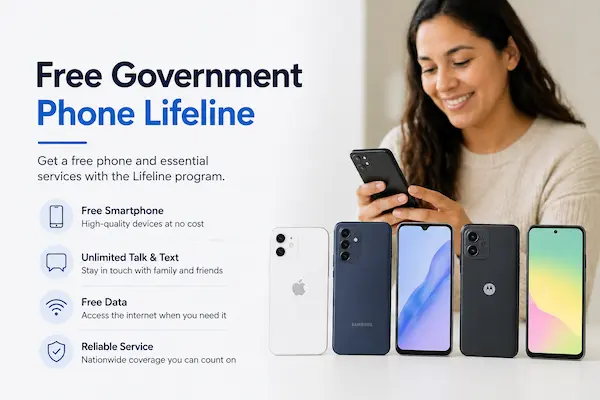
The federal Lifeline program gives qualifying low-income households a free smartphone and free monthly service with no contract, no credit check, and absolutely no monthly bill.
If you receive SNAP, Medicaid, or SSI — or if your household income is below the 2026 threshold — you could be just minutes away from approval.
LIFELINE PROGRAM
- Get a Free Smartphone
- Monthly Service Discounts
- Enhanced Tribal Support
- Flexibility of Choice
- Link Up Assistance (Tribal Lands)
You will remain on the same website
What Is the Free Government Phone Program?
The free government phone program runs through the federal Lifeline Assistance Program — an FCC initiative established in 1985 to ensure every American, regardless of income, has access to basic communications services.
Lifeline provides a monthly discount of up to $9.25 on qualifying phone or internet service — and up to $34.25 per month for households located on Tribal lands.
Participating wireless carriers use that federal subsidy to offer eligible customers a completely free package: a free government smartphone plus a monthly plan with unlimited talk, unlimited text, and a data allowance — all at $0 per month.
This isn’t a promotional deal that expires or requires a trade-in. It’s a permanent federal benefit available in every US state, territory, and Tribal land in the country, administered by the Universal Service Administrative Company (USAC).
Important: The Affordable Connectivity Program (ACP) ended in May 2024 and is no longer accepting applications. As of 2026, Lifeline is the only active federal program providing free wireless service to qualifying low-income households.
Who Qualifies for a Free Government Cell Phone?
Understanding the free phone eligibility requirements is the fastest way to know if you can get started today.
Your household needs to meet one of two criteria — income-based or program-based. You don’t need both.
You qualify by income if your household gross earnings are at or below 135% of the Federal Poverty Guidelines. For 2026, that means approximately:
- 1-person household: up to ~$20,331/year
- 2-person household: up to ~$27,594/year
- 4-person household: up to ~$41,625/year
You qualify automatically by program participation if you or anyone in your household is enrolled in any of the following:
- SNAP (food stamps / Supplemental Nutrition Assistance Program)
- Medicaid — getting a free phone with Medicaid is one of the fastest approval paths available
- SSI (Supplemental Security Income)
- Federal Public Housing Assistance (Section 8)
- Veterans Pension or Survivors Benefit
- Qualifying Tribal programs (BIA General Assistance, Tribal TANF, FDPIR)
Program-based eligibility is the fastest route to approval. SNAP and Medicaid enrollments are often verified instantly through the National Verifier’s federal database connections — no documents required in most cases.
What Do You Actually Get With a Lifeline Free Phone?
Here’s what a standard free government cell phone plan includes in 2026:
- A free smartphone shipped directly to your address — Android at most carriers, iOS at select providers
- Unlimited domestic talk and text — no per-minute or per-message caps
- Monthly high-speed data — typically 4.5 GB to 15 GB per month depending on carrier and state
- Mobile hotspot access — required by federal rules on all Lifeline devices
- Free phones no contract — no lock-in, no cancellation penalty, no commitment
- No credit check — qualification is based on income or government program status only
States like California and Tribal communities receive enhanced benefits — access to free 5G government phones at select carriers, additional state-funded supplements, and higher data allowances beyond the federal baseline.
Which Government Phone Companies Are Active in 2026?
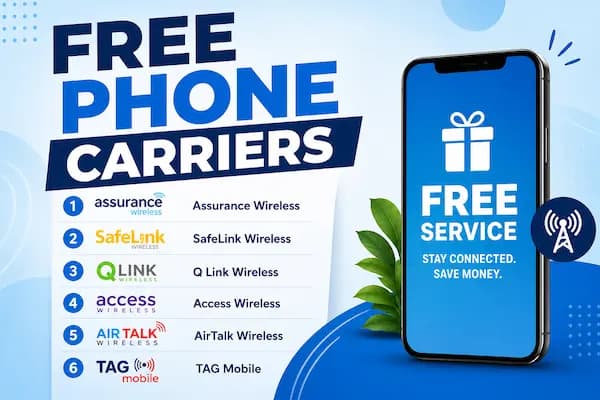
Several major government phone companies participate in Lifeline, and the quality of their plans varies considerably. Here’s a quick breakdown of the most reliable options:
- Assurance Wireless — T-Mobile 4G LTE/5G network; free Android smartphone plus unlimited talk, text, and data; currently running a 2x data promotion through April 2026; one of the largest and most trusted government phone service providers in the US
- SafeLink Wireless — Verizon and AT&T networks depending on state; available in all 50 states; the leading option for a SafeLink wireless free phone with strong rural coverage
- AirTalk Wireless — T-Mobile network; one of the few carriers consistently offering iPhone models to qualifying applicants; known for transparent device availability by state; a top pick for AirTalk wireless free phones including iOS devices
- Q Link Wireless — T-Mobile network; strong BYOD support for those with unlocked devices; fast activation; widely chosen for Qlink wireless free phone enrollment
- TAG Mobile — up to 15 GB of data per month plus free international calling to 200+ countries; ideal for households with heavier data needs
- Access Wireless — simple enrollment, fast shipping, solid coverage in most states
For a full side-by-side comparison of all major providers — including coverage maps, data amounts, device types, and state availability — read our detailed guide on the best free phone carriers in 2026.
Can You Get a Free iPhone Through the Government Phone Program?
Yes — but the availability depends on the carrier you choose, not on the federal program itself.
Lifeline provides the service discount. The device comes from the carrier. Most providers ship Android smartphones, but AirTalk Wireless has consistently offered free government iPhones in select states to qualifying applicants, depending on current inventory.
If you specifically want an iOS device, check AirTalk’s availability in your state before applying.
There’s also a separate path through Verizon. For those who want a current-generation iPhone — including the iPhone 17e, which Verizon is offering at no upfront cost with a new line and no trade-in required as of April 2026 — the carrier promotion route is worth exploring. And for users on Verizon-affiliated Lifeline brands like SafeLink and TracFone, free service with a basic device is available. Our full guide on how to get a free iPhone through Verizon covers both paths clearly.
T-Mobile and Verizon: Free Government Phones on Major Networks
Two of the most common questions are whether you can get a Verizon wireless free government phone or access the Lifeline program directly through T-Mobile.
T-Mobile doesn’t offer Lifeline under its own brand, but it operates Assurance Wireless — which runs on the full T-Mobile 4G/5G network. If you’re looking for a T-Mobile free 5G phone through the government program, Assurance is the primary path. The coverage, speed, and plan quality are equivalent to standard T-Mobile consumer plans.
Verizon participates in Lifeline directly in four states (Iowa, New York, North Dakota, and Wisconsin) for home phone and internet service. For mobile Lifeline service on Verizon’s network everywhere else, SafeLink Wireless and TracFone are the primary nationwide options.
For a detailed breakdown of T-Mobile’s commercial free phone deals alongside the Lifeline program, read our guide on Assurance Wireless and T-Mobile free phones — including which path makes sense depending on whether you’re a business user or a Lifeline-eligible individual.
How to Apply for a Free Government Phone Online
The application process is straightforward and entirely online. Here’s the fast version:
- Check eligibility — Go to checklifeline.org. Enter your state, household size, income, or qualifying program. Many applicants are confirmed instantly without uploading any documents.
- Choose a carrier — Use the “Companies Near Me” tool at lifelinesupport.org/companies or go directly to a provider like Assurance Wireless, SafeLink, Q Link, or AirTalk.
- Complete the enrollment form — Provide your name, address, date of birth, and last four digits of your Social Security number. Upload proof of eligibility if required.
- Receive your free phone — Most carriers ship your device within 3–7 business days. Some local enrollment locations activate service the same day you apply.
For the complete walkthrough — including what documents are accepted, what to do if your application is denied, how the one-per-household rule works, and how to keep your benefit active year after year — read the full tutorial on how to apply for Lifeline online.
Free Phone Plans: Keeping Your Service Active
Once you have your free cell phone service, two simple rules keep it running at no cost.
Use your phone at least once every 30 days. A single call, text, or data session is enough. Inactivity triggers automatic suspension.
Recertify your eligibility every 12 months. USAC sends an annual recertification notice. You must confirm your ongoing income or program status — it takes just a few minutes online. Fail to respond by the deadline and your benefit ends immediately.
Your Lifeline device is yours to keep regardless of future eligibility changes. If you lose eligibility later, the same carriers typically offer affordable prepaid free phone service plans starting around $15–$25/month for former Lifeline customers.
Apply Today — Free Service Is Waiting
The Lifeline program is fully active, fully funded, and accepting applications right now in every US state.
If your household qualifies — through income, SNAP, Medicaid, or any qualifying program — a free government phone with free monthly talk, text, and data is available to you. The application is free, takes less than 10 minutes, and many people are approved the same day.
Start at checklifeline.org, confirm your eligibility, choose the carrier with the best coverage in your area, and get your phone on its way.
Explore more guides on carriers, eligibility, iPhones, and application walkthroughs at DigitalCasp — your independent resource for navigating government phone programs in 2026.
Disclaimer: This content is for informational purposes only. DigitalCasp is not affiliated with, sponsored by, or in any way connected to the FCC, USAC, or any wireless carrier mentioned in this article. Program terms, eligibility requirements, carrier availability, and benefit amounts may change without notice. Always verify current details at official government sources before applying.