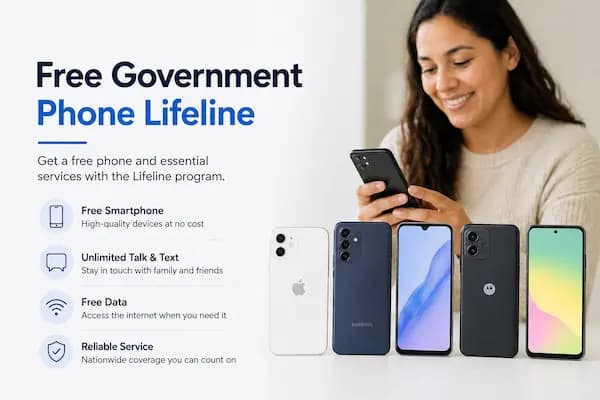
The best free phone carriers in 2026 are still offering real smartphones and real service at no cost.
Thanks to the federal Lifeline Assistance Program, millions of qualifying Americans can get a free phone with unlimited talk, text, and monthly data — without signing a contract or paying a monthly bill.
Here’s the complete breakdown of which carriers are worth your attention this year — and what each one actually gives you.
What Are Free Phone Carriers and How Do They Work?
Free phone carriers are wireless providers that participate in the federal Lifeline program — an FCC initiative established in 1985 to ensure low-income Americans have access to essential communications services.
The way it works is simple: the government provides a monthly subsidy of up to $9.25 per household (up to $34.25 on Tribal lands) to participating carriers. Those carriers use that funding to offer qualifying customers free or deeply discounted phone plans — and many include a free smartphone device as part of the enrollment package.
You don’t pay the carrier. The carrier gets reimbursed by the Universal Service Administrative Company (USAC) on your behalf. The result is a fully functional phone and service plan that costs you nothing, as long as you qualify and stay enrolled.
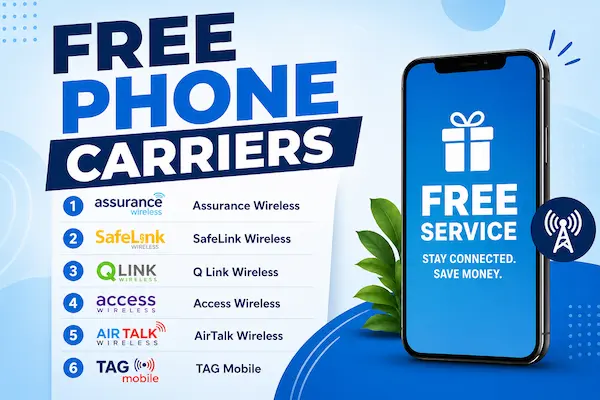
Top Free Phone Carriers in 2026
Not all Lifeline carriers are created equal. They differ in network coverage, data allotments, device quality, and the states they serve. Here’s a breakdown of the best options available right now.
1. Assurance Wireless
Network: T-Mobile (4G LTE / 5G)
Assurance Wireless is consistently ranked as one of the top free phone carriers in the country, and for good reason.
As a T-Mobile subsidiary, it runs on one of the most extensive nationwide networks in the US. Qualifying customers receive a free Android smartphone, unlimited talk and text, and a generous monthly data allotment that varies by state.
As of April 2026, Assurance is running a limited-time promotion offering twice the standard data — making it one of the best-value Lifeline plans currently active. It’s available in most states and doesn’t require a credit check or a contract.
2. SafeLink Wireless
Network: Verizon / AT&T (varies by state)
SafeLink Wireless is a TracFone brand backed by Verizon, making it a strong option for areas where Verizon’s network dominates — particularly in suburban and rural regions where T-Mobile’s 5G coverage may be less dense.
SafeLink offers free monthly service with unlimited talk, text, and a set data allotment depending on your state. Device options vary, but qualifying customers typically receive a basic Android smartphone at no cost. SafeLink is one of the most widely available government phone carriers, operating in all 50 states.
3. Q Link Wireless
Network: T-Mobile
Q Link Wireless is one of the largest independent Lifeline carriers in the US. It offers free talk, text, and data — with plans that include up to 4.5 GB of high-speed data per month in many states, and more in states with enhanced Lifeline funding.
Q Link also supports Bring Your Own Device (BYOD), which means if you already have an unlocked compatible phone, you can activate free Lifeline service without waiting for a device to ship. This makes it one of the fastest ways to get your free service active.
4. Access Wireless
Network: T-Mobile
Access Wireless focuses heavily on streamlined enrollment and fast device delivery. Its free plans include unlimited talk and text plus a standard data allotment, and it participates in the Lifeline program in dozens of states.
It’s a solid choice for first-time Lifeline applicants who want a simple, no-fuss enrollment experience.
5. AirTalk Wireless
Network: T-Mobile
AirTalk Wireless has gained attention for offering some of the strongest device upgrade options in the Lifeline space, including iPhone models to qualifying applicants in certain states.
Unlike many carriers that only provide basic Android handsets, AirTalk frequently stocks iPhone models — making it one of the few free phone carriers where you might receive an iOS device rather than Android. Applicants can check device availability before applying, which is a helpful feature.
6. TAG Mobile
Network: T-Mobile / AT&T (varies by state)
TAG Mobile is a Texas-based Lifeline provider with a strong reputation for generous data allocations. Qualifying customers in many states can receive up to 15 GB of high-speed data per month, along with unlimited talk and text and free international calling to over 200 countries and territories.
If international calling is important to you, TAG Mobile stands out as one of the few free phone carriers that includes this feature in its standard Lifeline plan.
How to Choose the Right Free Phone Carrier for You
With several options available, picking the right carrier comes down to four factors:
- Coverage in your area: A free phone is only useful if you have signal. Check each carrier’s coverage map for your specific ZIP code before applying. T-Mobile-based carriers dominate urban areas; Verizon-based options like SafeLink may be stronger in rural zones.
- Data allotment: Plans vary from 4.5 GB to 15 GB per month depending on carrier and state. If you stream video or use navigation apps frequently, prioritize carriers with higher data caps.
- Device quality: Most carriers ship a basic Android smartphone. If an iPhone is important to you, AirTalk Wireless is worth checking first — but availability depends on current inventory.
- State availability: Not every carrier operates in every state. Use the USAC “Companies Near Me” tool at lifelinesupport.org/companies to see which Lifeline providers are active in your area.
What the Free Plans Actually Include
Across the major free phone carriers in 2026, here’s what a typical Lifeline plan includes:
- Unlimited domestic talk (calls within the US)
- Unlimited text messaging
- Monthly high-speed data: typically 4.5 GB to 15 GB depending on carrier and state
- Mobile hotspot access (federally mandated for Lifeline phones)
- A free Android smartphone (or iPhone at select carriers like AirTalk)
- No monthly bill, no contract, and no credit check
Plans vary by state. California and Tribal lands typically receive enhanced benefits — more data, better devices, or additional features — due to supplemental state and federal funding.
What to Watch Out For
There are a few common pitfalls when choosing a free phone carrier:
- One benefit per household rule: Only one Lifeline benefit is allowed per household, regardless of how many people live there. Make sure no one else at your address is already enrolled before applying.
- Annual recertification: Every 12 months, you must confirm you still meet eligibility requirements. Missing the deadline results in service termination. Set a reminder.
- 30-day usage rule: If your carrier provides free service without charging a monthly fee, you must use your phone at least once every 30 days or your service may be suspended.
- Scam providers: Only use FCC-authorized Lifeline providers. You can verify any carrier’s status at the official Lifeline Support website. Never provide your SSN or personal information to a provider that isn’t listed on the official Lifeline company list.
The ACP Is Gone — Lifeline Is What Remains
If you’ve heard about the Affordable Connectivity Program (ACP), it’s important to know that ACP funding ended in May 2024. New ACP applications are no longer being accepted.
As of 2026, the Lifeline program is the only active federal program providing free or discounted wireless service to qualifying households. It’s fully funded, fully operational, and available in every US state, territory, and Tribal land.
Any website claiming you can still apply for ACP in 2026 is either outdated or misleading. Stick to the Lifeline program and its authorized carriers.
How to Apply for a Free Phone Through Any of These Carriers
The application process is consistent across all Lifeline carriers:
- Visit the official National Verifier at checklifeline.org to check your eligibility
- Use the “Companies Near Me” tool to find participating carriers in your state
- Go directly to your chosen carrier’s website and complete their enrollment form
- Upload proof of eligibility (income or program documents dated within the past 12 months)
- Wait for approval (typically 1–2 business days online) and receive your free phone by mail
Alternatively, apply directly through the carrier and let them submit your National Verifier application on your behalf — many carriers simplify the process this way.
Final Word on Free Phone Carriers in 2026
The free phone carrier landscape in 2026 is strong. Assurance Wireless leads on network quality and plan value, SafeLink is the go-to for Verizon coverage areas, Q Link is the best option for BYOD users, and AirTalk stands out for those hoping to receive an iPhone.
The right choice depends on where you live, what device you want, and how much data you need. But the most important step is the first one — checking whether you qualify and applying through an official, FCC-authorized provider.
Disclaimer: This content is for informational purposes only. We are not affiliated with any wireless carrier, government agency, or the FCC. Program details, carrier availability, and device options may change at any time. Always verify eligibility and current offers at official program websites before applying.